



NICEPH Login: Account Access, Password Help and Safety Checks
Login at NICEPH gives returning users a direct way back into their accounts. Enter the correct username and password, use Remember only on a trusted device, and choose Forgot Password if the credentials no longer work. New users can switch to Register to create an account.
NICEPH Login Steps
The Login screen at Niceph is built around two credentials: Username and Password. There is no need to work through a long sequence before reaching an account. The important part is entering the same information connected to the existing account and checking it carefully before pressing Login.
A normal Login takes only a few steps:
- Open the NICEPH Login window.
- Make sure Login is selected instead of Register.
- Enter the correct Username.
- Type the account Password.
- Use the visibility icon if the password needs to be checked.
- Decide whether to select Remember.
- Press the blue Login button.
The distinction between Login and Register is small visually but important in practice. A returning user should stay on Login. Register is intended for someone creating a new account rather than trying to recover access to an existing one.
The screen also includes an age and Terms confirmation. Before entering an account, users are confirming that they are at least 18 years old and have read the Terms and Services.
A clean Login attempt is usually better than several rushed attempts. Check the username, reveal the password if needed, then submit once with confidence.
Username and Password Entry
Most Login failures begin with something simple: The account details entered are not exactly the details originally used.
Enter the Correct Username
The first field is specifically labeled Username. That matters. A phone number or email address should not automatically be treated as a substitute unless NICEPH explicitly accepts it for Login.
Before pressing Login, check for:
- An old username saved in the browser.
- A copied username with an extra space at the beginning or end.
- A similar username belonging to another account.
- A spelling difference caused by typing too quickly.
Imagine an account uses the username LuckyMarco88, but Google Chrome autofill inserts LuckyMarco8 from an older saved entry. The difference is only one character, yet Login will fail every time until the saved value is corrected.
Copying credentials can be convenient, but it can also copy invisible spaces. When a username seems correct and still fails, typing it manually once is often a useful test.
Check the Password Before Submitting
Passwords are less forgiving. Capital letters, numbers, and symbols must match the saved password exactly.
If the password field contains something like eight hidden dots, there is no easy way to notice whether one character was mistyped. The visibility icon solves that problem. Use it before Login when there is any doubt, especially on a mobile keyboard where uppercase letters and symbols can be easy to miss.
A common situation happens after a password change. Samsung Internet, Google Chrome, or another browser may continue filling the previous password. The field looks complete, so it is easy to assume the password is correct. In reality, the browser is doing exactly what it was told months ago.
When Login suddenly stops working after a password update, browser autofill should be one of the first things checked.
Remember Login on Personal Devices
The Remember checkbox adds convenience, but it should be used selectively.
On a personal phone that stays locked with a PIN, fingerprint, or Face ID, selecting Remember can make repeated Login sessions less tedious. On a shared laptop, office computer, internet café machine, or borrowed phone, leaving it unchecked is the better choice.
The practical rule is simple:
- Personal device: Remember may be convenient.
- Shared device: Leave it off.
- Temporary device: Leave it off and log out when finished.
- Device another person can unlock: Treat it as shared.
Remember should not be understood as a security feature. It exists to reduce repeated entry of Login information. Convenience is useful, but only when control of the device is equally strong.
There is also an important difference between closing a browser tab and logging out. Closing Chrome does not always mean a remembered session disappears. If another person regularly uses the same device, completing a proper logout gives better account control.
Forgot Password and Account Recovery
The Forgot Password link exists for the moment when another Login attempt is unlikely to solve the problem.
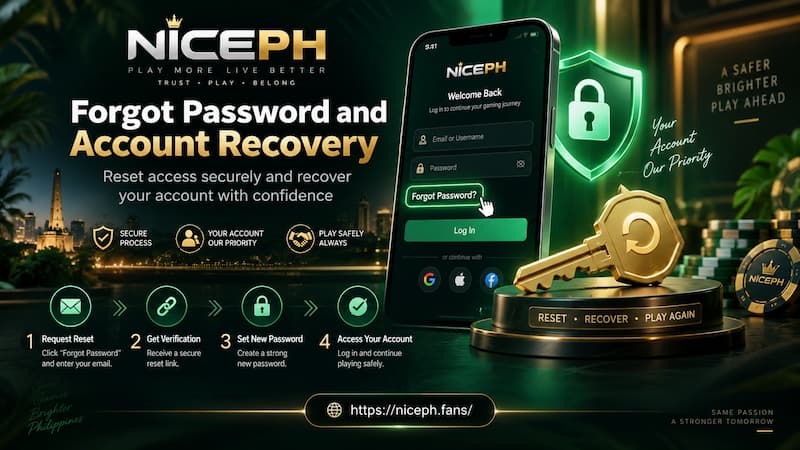
Forgot Password and Account Recovery
If the username appears correct but the password cannot be recalled confidently, guessing again and again usually adds confusion. A recovery attempt is cleaner than cycling through five or six possible passwords.
Use Forgot Password when:
- The password has genuinely been forgotten.
- Browser autofill keeps inserting an outdated password.
- The password was recently changed and the current version is unclear.
- Several careful Login attempts have already failed.
NICEPH should remain the source of the recovery steps themselves. If the recovery screen asks for a specific account detail, follow that instruction directly. Do not assume in advance that recovery will use SMS, email, OTP, or identity documents unless those options are actually presented during the process.
Recovery or Another Login Attempt?
There is a useful dividing line.
If a typing mistake is obvious, correct it and try Login again. If the correct password is genuinely uncertain, move to recovery instead.
For example, entering NicePlayer2026! instead of NicePlayer2026? is a clear typing issue. That deserves one corrected attempt. But if the choice is between four completely different passwords stored from different months, recovery is more sensible than trial and error.
The goal is not to make as many Login attempts as possible. The goal is to identify what is wrong.
Login or Register
Login and Register solve different problems.
Login is for an existing account. Register is for creating a new one.
The NICEPH window makes both choices visible at the top, and there is also a Register now link below the Login form. That makes moving to registration easy, but an existing user should not create another account simply because one Login attempt failed.
Before considering registration again, an existing user should:
- Confirm the username.
- Recheck the password.
- Remove outdated autofill credentials.
- Use Forgot Password if needed.
Creating a second account can make account management more confusing, particularly when activity, balances, bonuses, or personal information are already connected to the original username.
Registration is a starting point. Password recovery is the correct path when an existing account becomes difficult to access.
Login Problems and Practical Checks
A useful Login troubleshooting routine should narrow the problem down instead of throwing ten unrelated fixes at it.
Credentials Are Rejected
Use this order:
- Confirm Login is the active tab.
- Check the username character by character.
- Remove spaces created by copying and pasting.
- Reveal the password and inspect it.
- Check capital letters, numbers, and symbols.
- Delete an old autofill entry if the browser is inserting one.
- Use Forgot Password when the password remains uncertain.
This order matters because it starts with the simplest causes and only moves toward recovery after obvious credential errors have been eliminated.
Login Button Does Not Complete Access
Sometimes the credentials may be correct but the Login process does not move forward cleanly.
Try a few focused checks:
- Confirm the internet connection is stable.
- Reload the page once.
- Reopen the Login window.
- Start a fresh browser session.
- Check whether the browser is stuck on an older saved session.
- Avoid pressing Login repeatedly while the connection is still loading.
On a weak mobile connection, tapping the button five times will not make the request complete faster. Waiting briefly, reconnecting, then submitting once is cleaner.
If Google Chrome appears stuck, opening a fresh Incognito window can also help determine whether cached data or a saved session is interfering with Login. That does not automatically mean the account has a problem.
Repeated Login Failures
When several careful attempts fail, stop changing multiple things at once.
A better approach is to isolate the cause:
- Is the username definitely correct?
- Is the password known, or merely guessed?
- Is autofill inserting old information?
- Is the browser holding an outdated session?
- Is account recovery now the sensible next step?
Changing the username, password, browser, and device all at the same time makes it harder to understand which action actually solved the issue.
Account Safety Before Login
Login security begins before the password is typed. Check that the NICEPH address is familiar before entering account information, and review privacy policy if you want to understand how account and personal data are handled. Be especially careful with links received through unexpected messages, group chats, social media comments, or pop-up advertisements.
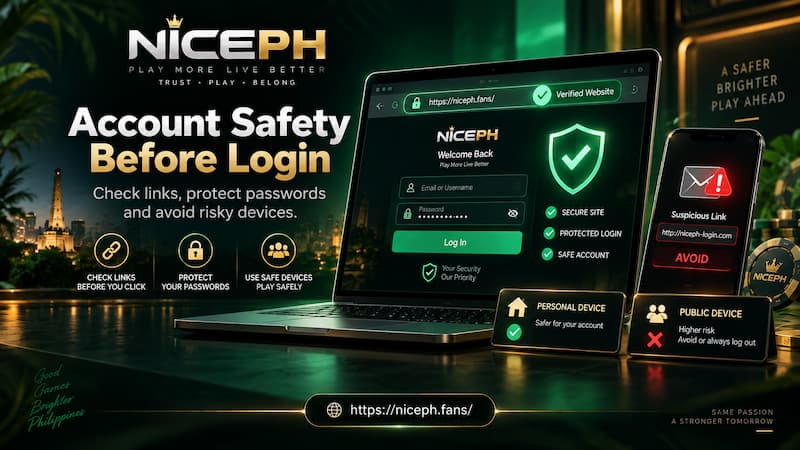
Account Safety Before Login
A fake Login form does not need to look crude. It can imitate colors, buttons, and field layouts closely enough to feel familiar. The safest habit is to check where the Login page was opened from rather than judging it only by appearance.
Keep these habits around every account session:
- Do not send a password to another person for “Login assistance.”
- Avoid saving credentials on public computers.
- Leave Remember unchecked on borrowed devices.
- Log out after using a temporary device.
- Be cautious when a message creates urgency around account access.
- Review autofill entries if old passwords keep appearing.
The most exposed moments are usually very ordinary: Opening the Login page, copying credentials, using browser autofill, enabling Remember, and recovering a password. Small decisions at those points protect the account better than complicated security habits that are rarely followed.
Age and Terms Confirmation
The Login window includes confirmation that the user is 18 years old and has read Terms and Conditions.
This is not just decorative text below the button. Login is being used alongside those conditions, so users should understand them before accessing an account.
Anyone who has not read the Terms should review them before continuing, particularly where account eligibility, deposits, withdrawals, verification, bonuses, or account restrictions may be involved.