



Can Card Tracking Help in Tongits?
Card Counting in Tongits means paying attention to cards that have already become visible and using that information before making the next move. The aim is practical: Know which melds are still realistic, which outs are already gone and which conclusions about an opponent’s hand are simply guesses.
Card Counting in Tongits Starts With Visible Information
Tongits does not reward card counting in quite the same way as blackjack. There is no running count that tells you whether a deck has become rich in high or low cards. Instead, the useful information comes from the cards you can physically account for during the round.
A standard game uses one 52-card deck for three players. The dealer begins with 13 cards, while the other two receive 12 each. Once those hands are dealt, only 15 cards remain outside the three starting hands. That alone makes every confirmed card surprisingly valuable.
The cleanest way to think about card tracking is to separate the deck into three groups.
Cards With Known Locations
These are the easiest to work with:
- Cards in your hand
- Face-up melds on the table
- Cards added to existing melds through sapaw
- Face-up discards
- Cards revealed when somebody takes a discard and exposes a new meld
You do not need to remember all 52 cards. You need to notice the ones that affect the combinations you are actually considering.
Cards That Can Be Inferred
Suppose an opponent picks up 6♥ and immediately exposes 4♥-5♥-6♥. You now know exactly why that card was taken.
Other signals are weaker. A player repeatedly keeping middle cards, for instance, may be building runs, but there is no proof. Good tracking separates confirmed information from reasonable suspicion.
Cards That Remain Hidden
Two areas stay uncertain for much of the round: Concealed opponent cards and the stock.
That distinction matters. If you have not seen 9♣, it does not mean 9♣ is waiting in the stock. It may already be sitting in another hand.
Unseen and available are not the same thing.
That single habit prevents many poor Tongits decisions.
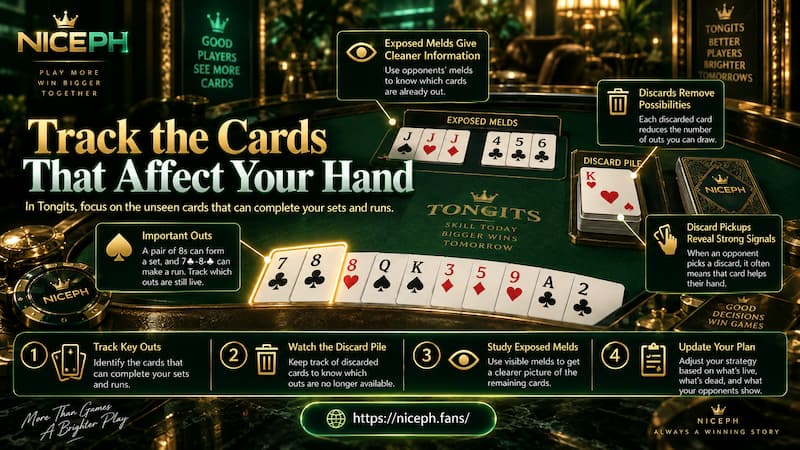
Track the Cards That Affect Your Hand
Trying to memorize every discard quickly becomes tiring and often gives less value than expected. A sharper approach is to identify your important outs first.
Track the Cards That Affect Your Hand
If your hand contains 8♠ and 8♦, the remaining 8♥ and 8♣ are immediately relevant. If you hold 7♣-8♣, then 6♣ and 9♣ deserve attention.
Those are the cards worth tracking closely.
Discards Remove Possibilities
Imagine you begin with 8♠ and 8♦.
At first, two unseen cards can complete a three-card set:
- 8♥
- 8♣
Several turns later, 8♣ appears in the discard pile.
Your situation has changed. There is now only one unseen eight that can complete the set: 8♥.
If that card later appears inside another player’s exposed meld, the pair is effectively dead as a route to a three-of-a-kind. Holding it indefinitely because “another eight might come” no longer makes sense.
This is where Card Counting in Tongits becomes useful. It turns vague hope into a concrete decision.
Exposed Melds Give Cleaner Information
A discard tells you that a card has left someone’s hand. A face-up meld tells you considerably more because several card locations become fixed at once.
Suppose the table shows:
6♦-7♦-8♦-9♦
If you are holding 10♦ and hoping to build around 8♦-9♦-10♦, that plan is already impossible using cards from your own hand because two of the required cards are committed elsewhere.
Sets work the same way. When three queens are visible, a lone queen in your hand has no realistic chance of becoming a set of three.
Discard Pickups Deserve Extra Attention
Under traditional Tongits rules, taking the top discard is more informative than drawing blindly from the stock. The discard must be used to form a qualifying meld, which is then exposed.
That creates a small burst of reliable information.
You see:
- Which card the player wanted.
- Which cards were already being held with it.
- Which rank or suit structure has now been completed.
- Which cards are no longer available for your own combinations.
A stock draw reveals none of that.
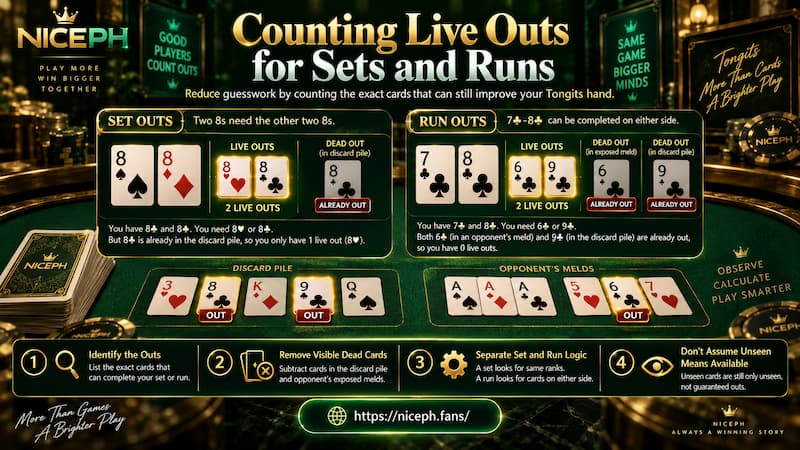
Counting Live Outs for Sets and Runs
The most practical form of card tracking is counting the exact cards that can improve an unfinished meld.
Counting Live Outs for Sets and Runs
Set Outs Are Easy to Reduce
Take this hand fragment:
8♠-8♦
Initially, 8♥ and 8♣ are possible completion cards.
Now suppose 8♣ appears in an exposed meld. You have one live rank out left.
Later, somebody discards 8♥.
There are now zero remaining cards capable of turning your pair into a three-card set.
At that moment, the pair should be evaluated for its deadwood value and alternative uses rather than treated as an unfinished set.
Run Outs Depend on Exact Suits
Runs require more precise tracking because suit matters.
With:
7♣-8♣
your obvious three-card completion possibilities include:
- 6♣
- 9♣
If 6♣ has already been discarded, 9♣ becomes the only direct outside completion for that two-card sequence.
A hand such as 6♣-7♣-8♣ is different again. It already forms a run, while 5♣ and 9♣ may extend it if doing so improves the rest of the hand.
A Live Card Is Still Only Unseen
This is the important limitation.
If 9♣ has not appeared, you cannot conclude that you have a one-card draw to complete the run. The 9♣ could be:
- In the stock
- In the left opponent’s hand
- In the right opponent’s hand
Card tracking tells you that an opportunity has not been eliminated. It does not tell you where the card is.
Better Discards Come From Better Tracking
Knowing which cards are gone is useful only if it changes your decisions.
The first improvement usually appears in discard selection.
Stop Protecting Dead Combinations
Players often become attached to pairs and two-card sequences simply because they looked promising at the start.
Consider:
5♠-6♠
Early in the round, both 4♠ and 7♠ give the sequence immediate three-card completion possibilities.
If both cards later become visible elsewhere, the value of protecting 5♠-6♠ changes dramatically.
One of those cards may now be the correct discard, especially if keeping both forces you to retain higher deadwood elsewhere.
Flexible Cards Deserve More Patience
Not every unmatched card is equally weak.
A 7♥ can be part of several structures:
- 5♥-6♥-7♥
- 6♥-7♥-8♥
- 7♥-8♥-9♥
- A set of sevens
If several relevant cards are still unseen, 7♥ has flexibility. Compare that with an isolated K♣ whose surrounding cards and matching kings are already heavily exposed.
Tracking makes that difference visible.
Low Risk Does Not Mean Risk Free
Opponent information can also influence what you throw.
If somebody has exposed 3♦-4♦-5♦, discarding 2♦ or 6♦ may let that player extend the run through sapaw, depending on the current situation and rules.
Still, avoid pretending you can identify a completely “safe” discard every time. Concealed hands remain concealed. Card tracking narrows possibilities; it does not remove them.
Reading Opponents From Strong Signals
A common mistake is to turn every action into a story.
An opponent discards a king, so they “must have a low hand.” Someone draws from the stock twice, so they “must be struggling.” Neither conclusion is reliable.
Card Counting in Tongits works better when observations are ranked by strength.
A Pickup Is Strong Evidence
When a player deliberately takes a discard and exposes the resulting meld, there is little interpretation required.
If 9♠ is picked up to expose 7♠-8♠-9♠, you have three confirmed cards and an obvious part of that player’s hand structure.
Update your mental picture immediately.
A Stock Draw Says Very Little
You cannot see a stock draw. Even the card discarded afterward may have been held for several turns rather than being the card just drawn.
That makes sequences such as “draw stock, discard Q♥” poor evidence for reconstructing the entire hand.
Experienced tracking stays disciplined: Confirmed cards first, behavior second.
Where Card Counting in Tongits Stops Helping
There is a point where tracking becomes speculation.
You cannot see most stock draws. Opponents may keep completed melds concealed when the rules allow it. A live out can remain trapped in somebody else’s hand until the round ends.
That places clear limits on probability estimates.
Suppose only one card can complete your intended run. You have seen every relevant card except that one. The conclusion is not “I will eventually draw it.” The correct conclusion is simply “That card has not yet been accounted for.”
Those sound similar, but they produce very different decisions.
The same caution applies to Draw or Fight situations. Visible melds and deadwood clues may help you estimate hand strength, but another player’s concealed cards can change the comparison completely.
A Practical Tracking Routine for NICEPH
There is no need to memorize an entire deck in real time. A compact routine works better, especially when playing quickly.
For a Tongits session connected with NICEPH, focus first on the exact room rules before relying on traditional assumptions. Online and app-based versions can differ in how Draw, Fight, Sagasa, sapaw and scoring are handled. Whether a table uses free play or PHP-denominated stakes does not change the card logic, but rule variations can change the value of a particular decision.
Track Your Outs First
Before watching opponents, know what you need.
If you have a pair, identify the two matching ranks. If you have a two-card suited sequence, identify its exact completion cards.
When one appears, mentally cross it off.
Remember Important Pickups
You do not need a photographic memory. Prioritize discard pickups because they expose intent and usually reveal additional cards.
“Player took 9♠ for 7♠-8♠-9♠” is far more valuable information than remembering six unrelated low-card discards.
Recalculate as the Table Changes
Do not continue playing the hand you imagined three turns ago.
A promising pair may become dead. A weak suited connector may suddenly gain value. An apparently disposable card may become dangerous once another player exposes a matching run.
Use a Three-Step Check Before Discarding
Before releasing a card, ask:
- Can this card still complete one of my realistic melds?
- Have its important partner cards already appeared?
- Does the visible table suggest that another player can use it immediately?
That takes only a few seconds once it becomes habitual.
Card Tracking Works Best as an Elimination Tool
Card Counting in Tongits is most valuable when it removes bad options.
It can tell you that an intended set is no longer possible. It can show that a run has only one remaining unseen completion card. It can help you notice when a discard pickup reveals a new threat or when protecting an old combination has stopped making sense.
What it cannot do is expose hidden cards or predict the next stock draw.
The strongest approach is therefore simple: Track confirmed cards aggressively, treat unseen cards as uncertain and use opponent behavior only after the hard information has been considered.
That does not make every decision obvious. Tongits would lose much of its character if it did. But it does replace a surprising amount of guesswork with decisions grounded in cards you have actually seen.