



How Betting Knowledge Has Evolved in the Philippines
Betting Expertise in Philippines has moved far beyond simply knowing a strong team, a favorite horse, or a popular game. Today, useful betting knowledge combines probability, market awareness, digital tools, regulation checks, record keeping, and the discipline to separate good information from noise.
From Traditional Betting to Formal Markets
Long before mobile screens put odds and statistics in one place, betting knowledge was built slowly. Horse racing, lotteries, and later sports wagering relied heavily on observation, memory, printed information, and conversations with people who followed a particular event closely.

From Traditional Betting to Formal Markets
A bettor who knew a horse’s recent form, a basketball team’s rotation, or the effect of travel on a provincial game might have held an information advantage simply because that detail was difficult to obtain.
The advantage was often local. Someone following the same racing stable every week could know more than a casual bettor who appeared only on race day. There were fewer numbers to process, but obtaining useful information demanded more effort.
Experience Was the First Edge
Early betting judgment was usually built around a few practical inputs:
- Previous results and recent form
- Familiarity with teams, horses, or competitors
- Injuries and lineup changes
- Venue conditions
- Personal observation
- Information shared within betting circles
That type of knowledge still has value. The difference is that it is no longer difficult to find.
Betting Expertise in Philippines now develops in an environment where millions of people can reach scores, statistics, news, and betting information within seconds. Philippine Statistics Authority data showed that 67.3% of people aged 10 and above used the internet in 2024, illustrating how ordinary digital access has changed the information environment.
Regulation Added Another Layer of Knowledge
Modern betting knowledge also includes knowing whether an activity belongs inside the regulated market.
PAGCOR’s Electronic Gaming Licensing Department currently covers local operations involving electronic casino games, sports betting, eBingo, online poker, numeric games, and several other gaming categories. That means understanding the operator and the applicable regulatory structure is now part of making an informed decision, not an administrative detail to consider afterward.
Odds Became More Than a Prediction
A common beginner question is simple: Who is going to win?
An experienced bettor asks something different: Is the offered price good enough for the chance of that outcome happening?
That distinction changed betting analysis.
Imagine a basketball team that you estimate has a 60% chance of winning. That opinion alone does not tell you whether a bet makes sense. Leveraging odds means comparing that estimate with the price you receive for accepting the uncertainty.
Reading Probability Behind the Price
Decimal odds can be converted into an approximate implied probability by dividing 1 by the odds.
A Simple Probability Check
At odds of 2.00:
- Divide 1 by 2.00.
- The implied probability is 50%.
- Compare that number with your own estimate.
- Decide whether the difference is large enough to justify the uncertainty.
If your analysis gives an outcome a 52% probability, a tiny difference may not mean much. If you consistently estimate it at 65% while the market price implies 50%, the situation deserves more attention.
This is where Betting Expertise in Philippines becomes more analytical. Picking winners feels satisfying, but evaluating the relationship between probability and price is a more demanding skill.
Margin and Expected Value
Betting markets are not priced as neutral probability tables. A margin is built into the available prices.
For that reason, a bettor can predict several winners correctly and still perform poorly if the prices accepted are consistently too short.
Expected value takes the analysis one step further. Instead of asking whether a single wager will win tonight, it asks whether repeatedly taking similar prices would make mathematical sense over a much larger sample.
A strong opinion and a good price are not the same thing.
That sentence captures one of the biggest changes in modern betting thinking.
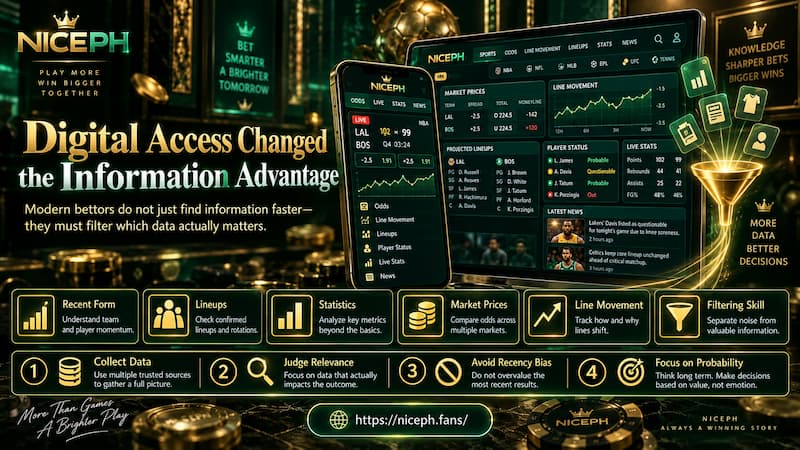
Digital Access Changed the Information Advantage
Twenty years ago, getting an injury update early could be valuable. Today, thousands of people may receive the same update within seconds.
Digital Access Changed the Information Advantage
The information advantage has therefore changed shape.
Instead of simply finding information, bettors now have to judge its importance.
Statistics Entered Everyday Betting
A modern bettor can check:
- Recent form
- Starting lineups
- Player availability
- Head-to-head results
- Home and away performance
- Possession or shooting data
- Market prices
- Pre-match line movement
- Live match statistics
The danger is obvious: More data can make analysis worse when every number receives equal weight.
Suppose a football team has won four consecutive matches. That sounds convincing until the details show three wins came against bottom-table opponents and the fourth required a late penalty. The record is factual, but the interpretation may still be weak.
Information Filtering Became the Real Skill
Older betting expertise often came from finding something other people did not know.
Modern betting expertise increasingly comes from ignoring information that everybody can see but few interpret properly.
That is a much harder skill.
Recent results can create recency bias. Famous teams can attract attention regardless of price. A dramatic previous meeting can stay in memory even when the current squads, coaches, injuries, and conditions are completely different.
The knowledgeable bettor does not need the largest spreadsheet. The goal is to identify the few variables that materially change the probability estimate.
Regulation Is Now Part of Betting Expertise in Philippines
The digital market also created a distinction that informed users cannot ignore: Local regulated gaming and offshore gaming are not the same thing.
The Philippines formally banned offshore gaming operations through the Anti-POGO Act of 2025. The law prohibits the conduct and offering of offshore gaming operations in the country and permanently revokes the authority to issue licenses for those operations.
Meanwhile, PAGCOR continues to regulate permitted domestic gaming categories, including locally licensed electronic gaming and sports betting.
Verification Comes Before Analysis
Before spending half an hour studying odds, statistics, or game mechanics, basic verification deserves attention.
A practical check can include:
- Identify who operates the service.
- Check which regulator or licensing structure applies.
- Confirm that the gaming category being offered matches that framework.
- Read the account, deposit, withdrawal, and verification conditions.
- Keep transaction records in PHP rather than relying on memory.
This sounds less exciting than predicting a match, but it reflects how betting knowledge has matured.
Good analysis cannot compensate for a poor understanding of where money is being placed.
Specialization Creates Deeper Knowledge
One of the easiest ways to weaken betting analysis is to follow everything.
A person jumping between NBA games, European football, boxing, volleyball, esports, and horse racing may have plenty of opinions but little depth in any one market.
Specialization works differently.
Familiarity Builds Context
Someone who follows one basketball league closely begins to recognize details that raw statistics may not immediately explain: Rotation changes, coaching tendencies, back-to-back scheduling, travel, matchup problems, or the effect of losing a specific defensive player.
Over time, those details create context.
The same principle applies to market types. A bettor who concentrates on totals may interpret pace and scoring efficiency differently from someone mainly studying moneyline outcomes.
Expertise grows through repetition in a narrow area, not through having an opinion on every event available that evening.
Bankroll Decisions Belong Inside the Analysis
Bet size is sometimes treated as a separate money-management topic. It should be part of the analytical process.
Two wagers can represent equally strong opinions but create very different financial risk depending on stake size.
A PHP500 bet and a PHP10,000 bet on the same selection do not become different predictions. They become different exposure decisions.
Records Expose Memory Bias
Keeping a simple betting log can reveal more than memory ever will.
Useful fields include:
- Date
- Event
- Market
- Odds taken
- Stake in PHP
- Closing price when available
- Result
- Reason for taking the bet
After 50 or 100 entries, patterns start becoming visible. Perhaps basketball totals perform better than match winners. Maybe live bets are consistently weaker than pre-match decisions. Perhaps the bettor remembers impressive wins far more clearly than small recurring losses.
Records turn confidence into something measurable.
NICEPH and Modern Online Gaming Knowledge
Betting knowledge is only one part of today’s wider digital gaming environment. Online casino users face a different set of decisions involving game rules, payout structures, account verification, promotions, payment procedures, and transaction records.
For a Philippine online casino brand such as NICEPH, useful knowledge begins with understanding the game being played rather than simply choosing a title because it looks familiar. A slot, baccarat table, blackjack game, and live dealer game each has a different structure, pace, and risk profile.
Casino Knowledge Uses Different Metrics
Sports betting revolves heavily around probability estimates and market prices. Casino play requires attention to other details:
- Game rules
- House edge
- Paytables
- Bonus conditions
- Deposit and withdrawal procedures
- PHP balance tracking
- Session limits
Confusing these two forms of expertise leads to poor decisions. A sports bettor analyzes uncertain external events. A casino user is dealing with games whose mathematical structure is built into the rules.
Recognizing that difference is itself part of becoming more knowledgeable.
From Better Predictions to Better Decisions
Betting Expertise in Philippines has evolved from knowing results and competitors into a broader decision process involving probability, pricing, digital information, regulation, specialization, and bankroll control.
The market itself has changed quickly. Electronic and online gaming generated PHP201.12 billion in Philippine gross gaming revenue during 2025, accounting for 50.77% of total industry GGR before the electronic segment weakened again during 2026. The movement in both directions is a reminder that digital gaming markets are dynamic rather than permanently moving along one straight growth line.
Access to more information is useful, but access alone is not expertise. The stronger advantage comes from knowing which numbers deserve attention, which stories should be ignored, how much uncertainty remains, and when the available price simply does not justify the bet.