


How Bonus Wheels Work in Slot Games
Bonus Wheel in slots is a secondary feature that can award credits, multipliers, free spins, jackpots, or access to another bonus round. The important part is not how dramatic the wheel looks, but how it is triggered, how its result is determined, and how the prize fits into the slot’s mathematics.
Bonus Wheel in Slots and Its Role in a Game
A bonus wheel usually sits outside the normal reel sequence. You spin the base game first, meet a qualifying condition, and then move into the wheel feature. From there, one spin can award a direct prize or open another stage of the bonus.
A typical sequence looks like this:
- Place a wager and spin the reels.
- Land the required Bonus, Wheel, Scatter, or feature symbols.
- Enter the wheel screen.
- Start the wheel or allow it to start automatically.
- Receive the result assigned to the winning segment.
That sounds simple, but wheel designs vary considerably. One game may offer nothing except credit prizes. Another may mix 10x and 50x multipliers with free spins, jackpots, and extra bonus rounds.
For players browsing slot games through NICEPH, the individual game’s paytable is therefore more useful than assuming every wheel follows the same rules. The mathematics belong to the slot itself and its provider.
How a Bonus Wheel Is Triggered
The wheel does not necessarily appear on every spin. A game first needs a trigger, and that trigger can take several forms.
Reel-Based Triggers
One familiar setup uses special symbols on the reels. For example, a slot might require three Wheel symbols anywhere in view, three Bonus symbols on particular reels, or a certain combination of Scatter symbols.
The details matter. Three symbols may be enough in one game while another requires four. Some need the symbols on consecutive reels; others accept them anywhere.
This is where checking the paytable before playing saves confusion.
Random and Feature-Based Triggers
Not every Bonus Wheel in slots comes directly from a symbol combination. A wheel can also be connected to:
- A collection meter filled during regular spins
- A randomly activated feature
- Special expanding or transforming symbols
- A free-spin round
- Another pick-and-win bonus
- A jackpot feature
Some slots even upgrade the wheel as certain items are collected, adding larger multipliers or unlocking additional prize sectors. Other designs can combine wheel triggers with mystery symbols or transforming symbols, so the trigger sequence should be checked in the game rules.
Trigger Conditions Worth Checking
Before focusing on the prizes, check whether the game specifies:
- The number of symbols required
- Which reels must contain them
- Whether a particular wager is needed
- Whether the wheel can trigger during free spins
- Whether the feature can retrigger
Those details tell you far more about the feature than the animation does.
How the Wheel Result Is Determined
A digital slot wheel may look like a physical prize wheel, complete with momentum, bouncing pointers, and a slow final click between two tempting sectors. That presentation should not be confused with the underlying result mechanism.
RNG-Controlled Digital Wheels
Modern electronic games can use a Random Number Generator, or RNG, to produce random outcomes according to the mathematical rules built into the game.
Technical gambling standards require RNG-generated results to follow their theoretical probabilities and remain unpredictable. They also prohibit adaptive systems that quietly change outcome probabilities because of what happened on previous plays.
In practical terms, the animated wheel can be the visual representation of an electronically generated result. The fact that the pointer appears to move slowly past a jackpot does not mean physical momentum nearly carried it onto that prize.
A digital wheel can look mechanical without its result being decided by real-world wheel physics.
That distinction clears up one of the most common misunderstandings around bonus features.
Mechanical Bonus Wheels
Physical gaming machines can use genuine mechanical devices in some designs. There, a physical wheel or another mechanical randomising component may contribute directly to the result.
Online slots are different. A graphic spinning across a phone screen should not automatically be treated as though every visible slice behaves like an equally sized section of a physical roulette-style wheel.
Wheel Segments and Actual Probability
Suppose a wheel contains 12 sections and one displays a jackpot. It is tempting to conclude that the jackpot chance must be 1 in 12.
That conclusion is only valid if the game rules actually assign equal probability to all 12 segments.
The visible size of a segment does not, by itself, reveal its mathematical weighting. When probability information is supplied, the game rules and paytable are more reliable than trying to estimate odds from the artwork.
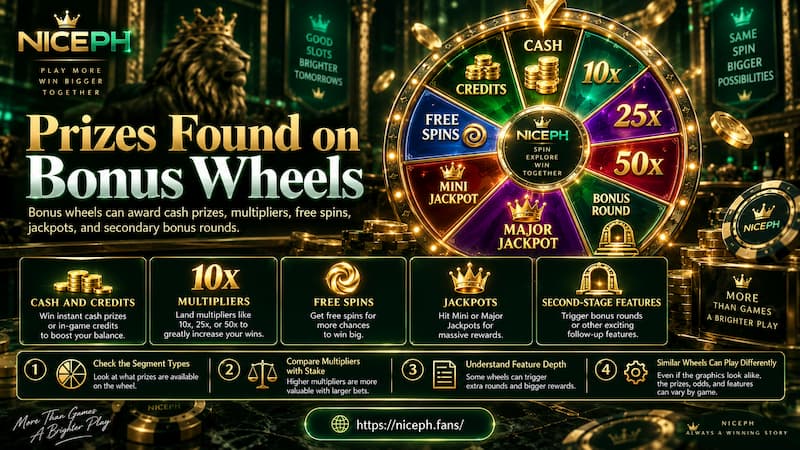
Prizes Found on Bonus Wheels
The appeal of Bonus Wheel in slots comes from the variety of results that can fit into one compact feature.
Prizes Found on Bonus Wheels
Cash, Credits, and Multipliers
The simplest wheel awards an immediate amount. A segment could show a fixed credit prize or a multiple of the qualifying wager.
For example:
- A 10x result on a ₱20 qualifying bet produces ₱200.
- A 25x result on a ₱20 bet produces ₱500.
- A 50x result on a ₱10 bet also produces ₱500.
The final two examples pay the same amount despite coming from different multipliers and stakes.
Free Spins and Enhanced Features
Other wheels award free spins rather than an immediate PHP prize. The wheel might determine whether the round starts with 8, 12, or 20 free spins, or it may attach a multiplier to the upcoming feature.
A more layered design can combine both. Landing on a Free Spins sector may lead to another selection that determines the multiplier or number of spins.
Jackpots and Secondary Bonuses
Higher-end wheel structures sometimes mix regular prizes with Mini, Minor, Major, or Grand jackpot sectors. Others use the first wheel only as a gateway.
You may land on:
- A fixed jackpot
- A progressive jackpot, where offered
- Another prize wheel
- An upgraded free-spin mode
- A larger multiplier range
- A second-stage bonus
This is why two games with nearly identical wheel graphics can play very differently.
RTP, Volatility, and the Bonus Wheel
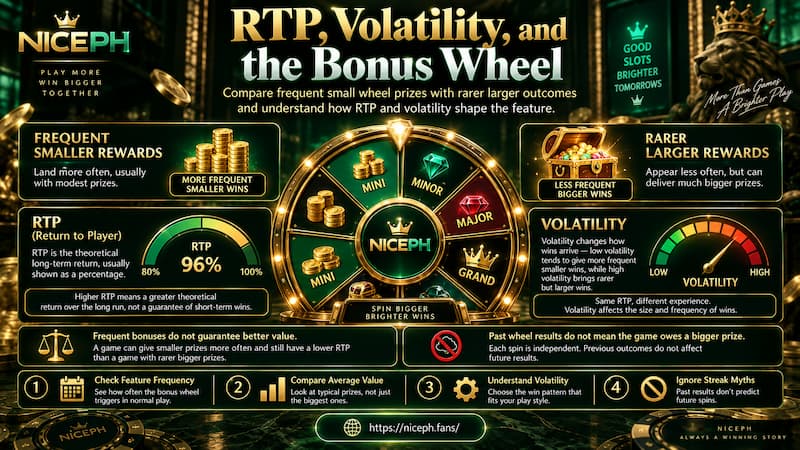
The wheel is not free mathematics added on top of the normal slot. Its trigger frequency and average prize value are built into the game’s overall model.
RTP, or Return to Player, represents the theoretical percentage returned over a very large number of plays under defined game conditions. It is not a prediction of what one person will receive during a short session.
RTP, Volatility, and the Bonus Wheel
Frequent Wheels vs Larger Wheels
Imagine two fictional slots.
Slot A triggers its wheel relatively often but fills most sectors with modest prizes. Slot B triggers less frequently but offers a wider range of higher-value outcomes.
Neither design automatically has the better RTP.
A frequent bonus can still have a low average value, while a rare feature can contribute significantly more whenever it appears. Volatility, feature frequency, prize weighting, and the base game all interact.
Previous Wheel Results Do Not Create a Debt
After five small wheel prizes, it can feel as though the feature “owes” a large one. RNG standards specifically reject adaptive behavior that alters the probability of future results in response to previous outcomes.
A streak of 5x results therefore does not establish that a 100x result or jackpot is now closer.
Bet Size and PHP Wheel Payouts
Bet size can affect the value of a wheel prize, but there is no universal formula across all slots.
A multiplier-based feature is easy to understand. If the wheel pays 20x the qualifying wager:
- ₱10 bet = ₱200
- ₱20 bet = ₱400
- ₱50 bet = ₱1,000
A fixed ₱500 prize behaves differently because its displayed amount may remain ₱500 regardless of stake, subject to the rules of that specific game.
Some games also change available features, jackpot eligibility, or prize values at particular bet levels. Others do not.
At NICEPH, check the information panel of the individual game before assuming that increasing a wager improves the probability of triggering the wheel. A larger stake can increase a bet-based payout without necessarily changing the trigger probability.
Reading a Bonus Wheel Before Playing
A bright jackpot sector naturally attracts attention. The useful information is usually a few taps away in the rules screen.
Check the Trigger First
Find out exactly how the feature starts. If the game needs three Wheel symbols, check whether they must appear on specific reels. If it uses a collection mechanic, see whether progress persists between spins or resets.
Separate the Prize Types
Read each wheel sector according to what it actually awards:
- PHP or credit value
- Bet multiplier
- Free spins
- Jackpot
- Feature upgrade
- Entry into another bonus
A “50” sector might mean ₱50, 50 credits, 50x the bet, or something completely different.
Read the Paytable and Game Information
Game rules should describe the available prizes and how gameplay functions before wagering. Established remote gaming standards also require rules and payout information to be made available to customers and games to operate according to those stated rules.
A Practical NICEPH Check
When comparing two wheel-based slots on NICEPH, look past which one has the larger animated jackpot slice. Open both information panels and compare the trigger, prize calculation, RTP where disclosed, jackpot requirements, and free-spin rules.
That comparison tells you how the games actually differ.
Common Bonus Wheel Misreads
Bonus wheels are designed to make the result feel dramatic. That drama can create a few misleading impressions.
Timing the Spin Button
Pressing the wheel button at the “perfect” moment is not a reliable way to steer an RNG-controlled outcome. The button may initiate the feature, but that does not mean your reaction speed controls the mathematical result.
Reading Near Misses as Signals
Seeing the pointer stop one position away from a jackpot can feel painfully close. It does not prove that the jackpot was nearly won in a mathematical sense, nor does it make the next wheel more favorable.
Random-game standards specifically address misleading representations and artificial near-miss behavior.
Assuming Equal Segments Mean Equal Odds
Twelve visually equal sectors do not automatically mean twelve equal probabilities.
Treat the graphics as presentation unless the rules confirm equal weighting. The paytable, probability information, and feature description provide the stronger basis for understanding the wheel.