



When to Double Down in Multi-Hand Blackjack
Double Down in Multi-Hand Blackjack means making one strong decision at a time, even with several hands open. The goal is simple: identify the totals that deserve an extra wager, read the dealer’s upcard correctly and adjust only when the table rules require it.
Double Down in Multi-Hand Blackjack
A double down increases the original wager, gives the hand exactly one additional card and then ends your drawing action on that hand. The attraction is simple: You commit more money when the situation is favorable. The harder part is recognizing that situation without letting other hands distort the choice.
Multi-hand blackjack can feel busier than a single-hand table, but the core decision stays local. Each hand is judged against the dealer’s upcard. For a different two-hand format, blackjack switch strategy adds a card-exchange decision before normal play begins
Unless you are using card counting or composition-dependent analysis, adjacent hands should not pull you away from basic strategy. Standard blackjack strategy still centers on the player total, dealer upcard and table rules.
One Dealer, Separate Decisions
Suppose three hands face dealer 6: hard 11, hard 16 and A-7. The 11 is a strong double, the 16 normally stands and A-7 is also commonly doubled under standard multi-deck rules.
The dealer card is shared. The decisions are not.
Hard Totals to Double
Hard totals are the easiest place to build a dependable doubling habit. In common four- to eight-deck blackjack, 9, 10 and 11 matter most.
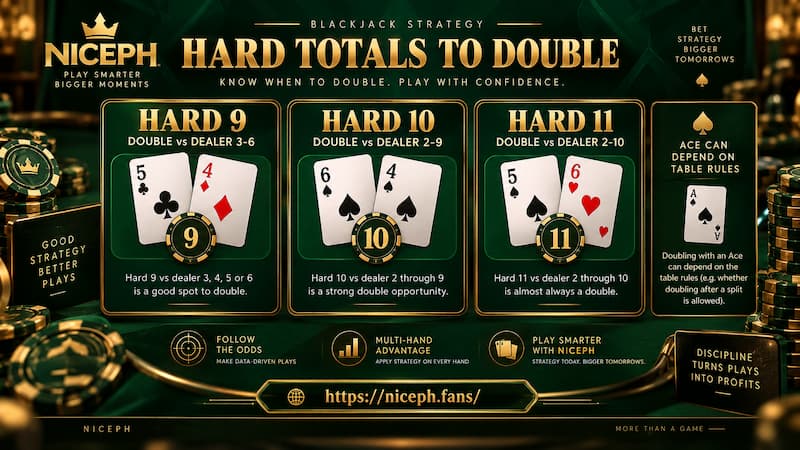
Hard Totals to Double
Hard 11
Under common multi-deck S17 rules, double 11 against dealer 2 through 10 and hit against an Ace. If the dealer hits soft 17, standard strategy commonly extends that double to the Ace.
Dealer 10 and Ace
A dealer 10 may look threatening, but hard 11 still supports a double under standard rules. The Ace is the boundary case because the correct move changes with H17 or S17.
That is why “always double 11” is too crude.
Hard 10
Hard 10 is normally doubled against dealer 2 through 9. Against 10 or Ace, hitting is generally preferred.
A pair of fives belongs in this discussion too. Two 5s make hard 10, and splitting them usually gives up a strong doubling opportunity. Treat 5-5 as 10 unless the specific rules say otherwise.
Hard 9
Hard 9 has a narrower range. Standard multi-deck basic strategy usually doubles against dealer 3 through 6 and hits against 2 or 7 through Ace.
It is a useful distinction because many players overextend the doubling logic of 10 and 11.
Soft Hands With Doubling Value
Soft totals are different because the Ace can count as 1 or 11. That flexibility lets you press weaker dealer upcards without the same immediate bust risk as a comparable hard hand.
Soft 13 to Soft 17
The progression is easier to remember as a pattern:
- A-2 and A-3: Double against 5 and 6.
- A-4 and A-5: Double against 4 through 6.
- A-6: Double against 3 through 6.
As the soft total improves, the doubling window widens against weaker dealer cards.
If one hand is A-6 and another is hard 10, do not compare them with each other. Compare each hand with the dealer’s upcard.
Soft 18
A-7 deserves special attention because it may call for a hit, stand or double.
Dealer Stands on Soft 17
With S17 rules, A-7 generally doubles against 3 through 6, stands against 2, 7 and 8 and hits against 9, 10 or Ace.
Dealer Hits on Soft 17
With H17 rules, the doubling range generally expands to dealer 2 through 6. Some H17 charts also make A-8 against dealer 6 a double when doubling is allowed.
Doubling Across Several Active Hands
The biggest multi-hand mistake is often psychological. One position wins, another loses and the next hand becomes a chance to “protect” the round or win back what just disappeared.
That is where good decisions turn into emotional ones.
Keep Each Hand Independent
Imagine three PHP 500 hands. The first loses, the second wins and the third is hard 11 against dealer 6.
The third hand does not become less attractive because PHP 1,000 has already moved through the other positions. If the rules call for a double, the correct action is still based on 11 versus 6.
At NICEPH when a multi-hand blackjack option is available, the practical discipline is the same: Finish the current hand correctly before mentally combining it with the rest of the round.
Several Doubles in One Round
If two PHP 500 hands both become valid doubles, another PHP 1,000 may be needed immediately. The mathematics has not weakened because two doubles appeared together.
The real question is whether the opening stakes left enough room to execute both decisions comfortably.
Table Rules That Change the Double
A strategy chart is only correct for the rules it assumes. Before following memorized ranges, identify the conditions of the blackjack game in front of you.

Table Rules That Change the Double
S17 and H17
S17 means the dealer stands on soft 17. H17 means the dealer hits on soft 17. That difference can change moves such as hard 11 versus Ace and A-7 versus dealer 2.
Double After Split
Double after split, or DAS, allows a new two-card hand created by a split to be doubled when the cards produce a suitable total.
DAS, deck count, soft-17 treatment and restrictions on allowable doubling totals can all change correct basic strategy and the game’s mathematical edge.
Restricted Doubling
Some games permit doubling only on 9, 10 and 11 or only on 10 and 11. A soft hand that would normally double may then become a hit.
If the multi-hand version is offered through live casino, check the selected table’s actual rules rather than assuming every blackjack game uses the same conditions.
Multi-Hand Bet Exposure
Multi-hand blackjack can turn a modest opening wager into a larger round once doubles and splits appear. That does not make the correct double less correct. It means stake sizing should happen before the deal.
Leave Room for the Decision
Suppose your comfortable round exposure is PHP 3,000. Betting PHP 1,000 on each of three hands uses the full amount before any double or split appears. Hard 11 against dealer 6 then creates a practical problem: Strategy says double, but the stake plan left no room.
A cleaner process is:
- Set the maximum amount you are comfortable exposing in one round.
- Divide it across the number of hands you intend to play.
- Leave room for likely doubles and splits.
- Let the cards determine the action, not regret about the opening bet.
This separation between strategy and stake sizing becomes more important as the number of hands increases.
A Practical Double-Down Check
Use the same sequence whenever a doubling decision appears.
Read the Hand
Identify whether the total is hard, soft or a pair.
Read the Dealer
Match it against the dealer’s visible card.
Check the Rules
Confirm H17 or S17, DAS and any restrictions on doubling totals.
Ignore the Other Hands
Do not protect a previous win or chase a previous loss by changing the current decision.
Confirm the Extra Stake
A double should be supported by both strategy and a sensible stake plan.
Double Down in Multi-Hand Blackjack becomes much cleaner once those ideas are separated. The cards determine whether the extra wager is justified, the rules refine the decision and the other hands affect exposure without rewriting the mathematics of the hand in front of you.