



How Strategy Changes in Blackjack Switch
Blackjack Switch Strategy begins before either hand is played. You first decide whether exchanging the second cards improves the pair of hands, then adjust hit, stand, double and split decisions for rules such as dealer Push 22. That extra decision changes the game from the opening deal onward.
Blackjack Switch Strategy Begins With Two Hands
Regular blackjack asks you to solve one hand against one dealer upcard. Blackjack Switch gives you two equal-bet hands and one extra choice: You may exchange the second card dealt to each hand before normal play begins.

Blackjack Switch Strategy Begins With Two Hands
That sounds like a small rule change. In practice, it creates an entirely different decision tree.
Suppose the initial deal is:
- Hand A: A-6
- Hand B: 10-4
- Dealer: 6
Switching the second cards changes the hands to A-4 and 10-6. You have not simply “improved” one hand; you have changed the expected value of two separate wagers at once.
Rules That Change the Mathematics
Common Blackjack Switch rules include:
- Two starting hands with equal wagers.
- The second card of each hand may be exchanged.
- Natural blackjack commonly pays 1:1 rather than 3:2.
- A 21 created by switching is generally treated as an ordinary 21, not a natural blackjack.
- Dealer 22 pushes against most surviving player hands instead of losing automatically.
- Doubling and splitting rules depend on the specific game version.
The dealer-22 rule is especially important. In ordinary blackjack, dealer 22 is a bust and every remaining player hand wins. Here, that same 22 can turn an expected win into a push.
Choosing the Better Switch
The most common mistake is looking at four cards and immediately trying to manufacture the prettiest individual hand. Blackjack Switch Strategy is stronger when both hands are evaluated as a pair.
Imagine these cards:
- Hand A: 10-5
- Hand B: 6-10
A player might instinctively chase a 20 wherever possible. But creating one strong hand can leave the second hand in a poor position. The dealer’s upcard also changes how valuable each arrangement is.
A practical sequence works better:
- Read both original hands.
- Build the two hands created by switching.
- Compare the strong and weak hand in each arrangement.
- Factor in the dealer’s upcard.
- Choose the combination with the better overall position.
Dealer 7 and 8 Require More Balance
Against a dealer 7 or 8, simplified switching strategy often puts greater emphasis on strengthening the weaker of the two hands.
That makes intuitive sense once you play enough rounds. A dealer 7 or 8 frequently finishes with a competitive total, so carrying one excellent hand and one obviously weak hand can be less attractive than creating two playable positions.
Protect Both Wagers
Suppose one arrangement leaves you with 20 and 12 while another produces 18 and 17. The 20 looks far more exciting, but the combined comparison is not automatically settled.
In Blackjack Switch, the strongest single hand is not always the strongest two-hand decision.
That is the mental shift that separates switching strategy from ordinary blackjack thinking.
Other Upcards Favor High-Value Hands
Against many dealer upcards outside 7 and 8, simplified strategy places more weight on producing the strongest high-value hand available.
Useful hand strength priorities commonly begin around:
- 21
- 20
- 19
- A-A
- 11
- 10
- 9
These are not instructions to switch blindly. They are reference points for comparing the two possible arrangements.
Strong Hands Can Still Be Broken
Blackjack players are trained to protect 20 and natural blackjack almost automatically. Blackjack Switch creates unusual exceptions because the decision affects two hands simultaneously.
Blackjack Is Not Always Sacred
Consider having a natural blackjack on one hand while the second hand is extremely weak. In certain card and dealer-upcard combinations, breaking the blackjack can improve the combined expectation of the two wagers.
It feels uncomfortable because conventional blackjack teaches the opposite.
The reason is straightforward: The value lost on one hand can occasionally be more than recovered by the improvement created across both hands.
This is also why rigid rules such as “never break 21” or “always make 20” are too crude for Blackjack Switch Strategy.
Dealer Upcard Changes the Same Four Cards
You may receive the exact same four player cards in two different rounds and make different switch decisions because the dealer shows a different card.
A dealer 5 creates different pressure than a dealer 8. Against the weaker upcard, keeping two respectable hands may be enough. Against a stronger dealer card, reshaping the pair becomes more valuable.
The four player cards do not tell the whole story.
Push 22 Changes Basic Strategy
Once the switch decision is finished, the game does not return to standard blackjack strategy. Dealer Push 22 changes the value of standing, hitting and doubling.
A blackjack chart designed for normal dealer-bust rules should not simply be copied across.
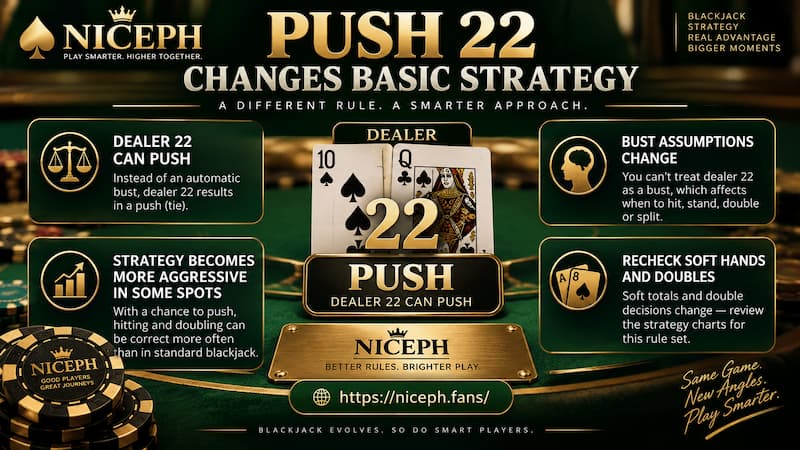
Push 22 Changes Basic Strategy
Hard Totals Need More Action
Consider standing on a marginal hard total against a weak dealer card. In regular blackjack, part of the value comes from letting the dealer draw into 22 and bust.
Blackjack Switch removes that win in many cases. Dealer 22 becomes a push instead.
As a result, some marginal hands require more aggressive play. Depending on the rule set, hitting ranges can widen and standing ranges can narrow.
A hard 13, for example, can behave differently against low dealer cards than many players expect from traditional blackjack.
Soft Hands Stay Flexible
Soft totals still benefit from the Ace’s ability to count as 1 or 11, but doubling decisions need their own Blackjack Switch chart.
Holding A-6 does not mean “double because I normally double A-6 against this card.” The Push 22 rule changes the dealer’s bust value, so familiar soft-double situations must be rechecked. For comparison, double down in multi-hand blackjack treats each active hand separately against the dealer upcard without the Push 22 rule.
Splitting Becomes More Selective
Pairs also need separate treatment.
Some splits that make sense in conventional blackjack lose value here because dealer 22 no longer produces the same payoff. Likewise, certain doubles become less attractive.
The important distinction is simple: Switching strategy decides which two hands you create. Basic strategy decides how you play those hands afterward.
Mixing those two stages leads to bad decisions.
Simple Strategy Versus Exact Strategy
Perfect switching calculations are difficult to perform mentally at normal table speed. You are comparing two hands, dealer strength and several possible future outcomes before the first hit.
That is why simplified switching systems are useful.
A well-known simplified method developed by Cindy Liu has been estimated to cost roughly 0.17 percentage points compared with optimal switching. More detailed switching rules can reduce the gap further, but they require considerably more memorization.
For most players, there is a practical trade-off:
- Simple rules are easier to execute consistently.
- Advanced rules improve precision.
- Perfect strategy demands far more study than memorizing ordinary blackjack basic strategy.
Consistency matters. A slightly simplified system used correctly is more useful than an advanced chart remembered incorrectly.
Two Hands Double the Starting Exposure
Blackjack Switch always begins with two wagers, so bankroll planning needs to reflect the full round rather than the amount placed on one hand.
For example:
- Hand A: ₱200
- Hand B: ₱200
- Initial exposure: ₱400
If a doubling or splitting opportunity appears later, the amount committed during the round can rise again.
That distinction matters in a Philippine casino setting because a player who thinks of ₱200 as the “bet size” may actually be exposing ₱400 before any additional decisions are made.
Bet size should remain separate from card strategy. Increasing a wager does not improve the mathematical quality of a switch, hit or stand.
Applying Blackjack Switch Strategy at NICEPH
Before using any memorized chart at NICEPH, confirm the rules attached to the specific Blackjack Switch game. Strategy accuracy depends on the version being played, not merely the game name.
Check the Rule Set First
Look for:
- Number of decks.
- Dealer hits or stands on soft 17.
- Blackjack payout.
- Double-after-split rules.
- How switched 21 is treated.
- Whether dealer 22 pushes.
- Any restrictions on resplitting or doubling.
A strategy chart built for an eight-deck game where the dealer hits soft 17 should not automatically be treated as exact for a different ruleset.
Errors That Cost Good Switch Decisions
Most mistakes come from bringing ordinary blackjack habits into a game that rewards a different order of thinking.
Using Standard Basic Strategy Unchanged
Push 22 changes the dealer’s downside, so some standard hit, stand, double and split decisions lose accuracy.
Improving Only One Hand
A beautiful 20 is not enough reason to switch if the second hand becomes significantly worse. Both wagers count.
Ignoring the Dealer Card
Dealer 7 and 8 deserve particular attention because simplified switching priorities often change around these upcards.
Treating Every 21 the Same
A natural blackjack and a 21 created after switching may receive different treatment under the rules. That distinction can affect both payouts and dealer-22 outcomes.
Switching Before Comparing Both Layouts
The cleanest Blackjack Switch Strategy process is:
- Compare the original two hands.
- Build the switched pair mentally.
- Read the dealer upcard.
- Choose switch or no switch.
- Play each resulting hand with Blackjack Switch-specific basic strategy.
That sequence keeps the game manageable. The attraction of Blackjack Switch is not that every hand becomes easier; it is that one extra decision gives you far more control over how the opening cards are arranged. Used carefully, that choice turns familiar blackjack into a sharper two-hand puzzle where balance, dealer strength and rule awareness matter on every deal.