



Why Filipino Bettors Are Turning to USDT for Online Payments
NICEPH explains why USDT attracts attention for online payments, how stablecoin transfers differ from ordinary e-wallet deposits, and where the limits begin. Availability depends on the cashier, blockchain network, wallet support, and current gaming rules.
USDT as an Online Payment Method
USDT, formally USD₮, sits in a different category from Bitcoin or other cryptocurrencies whose prices can move sharply within a few hours. Tether designed USD₮ as a stablecoin tied to the US dollar, with tokens backed by reserves disclosed through its transparency system.
That difference matters when someone is thinking about payments rather than speculation. A bettor who converts PHP into Bitcoin before making a payment takes on price risk immediately. If Bitcoin falls 5% before the funds are used or converted again, the payment effectively becomes more expensive. USDT is intended to avoid most of that short-term volatility.
A simple example makes the appeal clearer. Suppose ₱5,000 is converted into a dollar-pegged asset for later use. The main concerns become exchange rates, conversion spreads and transfer costs rather than whether the token itself suddenly drops 8% during the afternoon.
Stable Value Does Not Mean Zero Risk
USDT is designed to maintain a value close to one US dollar, but it is still a virtual asset. It is not PHP, a Philippine bank deposit or government-issued money.
That distinction is easy to overlook because the number displayed in a wallet often appears remarkably stable. For payment purposes, stability is useful; it should not be mistaken for a government guarantee.
One USDT, Several Blockchain Networks
USDT does not travel through one universal network. Tether currently supports the token across multiple blockchains, including Ethereum, Tron, Solana, TON, Aptos and others.
This creates flexibility, but it also introduces one of the most common points of confusion in crypto payments.
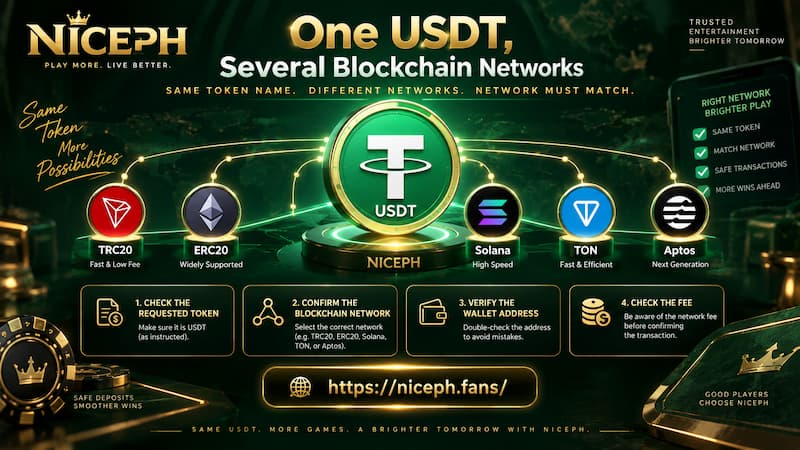
One USDT, Several Blockchain Networks
TRC20, ERC20 and Other Networks
A cashier might display USDT-TRC20 while a wallet contains USDT on Ethereum. Both balances may say “USDT,” yet they are not automatically interchangeable during a direct transfer.
The practical rule is simple:
- Check the token requested by the receiver.
- Check the blockchain network.
- Compare the wallet address carefully.
- Review the amount and fee before confirming.
Network Compatibility Comes First
Choosing the network with the lowest fee is pointless if the receiving address does not support it.
The correct USDT amount sent through the wrong network can create a much bigger problem than paying a slightly higher transaction fee.
For NICEPH users, that means the cashier information should always take priority over assumptions based on a previous crypto transfer.
Faster Transfers and More Wallet Control
Part of USDT’s attraction comes from how differently it moves compared with conventional banking.
Blockchain transfers can be initiated at night, on weekends or during holidays. There is no need to wait for a bank branch to open before sending tokens between compatible wallets.
That does not mean every payment is instant. Two separate processes are involved:
- The blockchain must confirm the transaction.
- The receiving service must detect and credit it.
A transaction can therefore appear as completed in a wallet while the corresponding account balance is still being processed.
Funds Stay Portable Between Compatible Wallets
USDT also gives experienced crypto users more control over where funds are held. The same token can potentially move between supported exchanges, wallets and services without first being converted back into PHP every time.
For someone already holding USDT, avoiding repeated conversions can make the payment flow feel cleaner. Someone starting with PHP, however, has an additional step: Buying USDT in the first place.
That is why “fast crypto payment” and “fast payment from PHP” are not always the same thing.
Philippine Payment Rules Have Changed
The online payment environment in the Philippines tightened considerably during 2025.
In August 2025, the Bangko Sentral ng Pilipinas ordered supervised institutions to remove links that gave users direct in-app access to gambling services from payment apps and websites. PAGCOR later described mandatory e-wallet delinking as part of the industry’s stronger payment safeguards.
For regular users, this matters because GCash, Maya and bank-based payment habits have long shaped expectations around online transactions. When familiar payment journeys become less direct, alternatives naturally receive more attention.
But there is an important line between interest and permission.
USDT Is Not an Automatic Replacement for E-Wallets
PAGCOR stated in December 2025 that licensed operators are prohibited from using cryptocurrencies for betting. Credit-card betting was also prohibited under the same safeguards.
So the logic should not be:
“E-wallet access became more restricted, therefore USDT is now the approved alternative.”
That conclusion would be wrong.
Crypto can be available legally through regulated virtual-asset services while still being restricted as a betting payment method under gaming rules.
Crypto Access and Betting Payments Are Separate
The BSP continues to supervise Virtual Asset Service Providers, or VASPs. Its public directory listed active providers such as Coins.ph, PDAX and other registered institutions, while 2026 guidance reinforced due-diligence expectations around virtual-asset activity.
This means owning, buying or transferring USDT through an authorized virtual-asset service is one issue. Using that USDT to fund a regulated gaming account is another.
For NICEPH, USDT should therefore be treated as available only when the current cashier explicitly supports it and when that payment method is compatible with applicable rules. A logo on an old article, mirror domain or third-party promotion is not enough evidence.
Regulatory Status Comes Before Convenience
The payment method that looks easiest is not necessarily the one that should be used.
Before depositing, check:
- Whether the operator and domain can be verified.
- Whether USDT is currently offered in the cashier.
- Which blockchain network is supported.
- Whether deposits and withdrawals use the same method.
- Whether additional KYC or source-of-funds checks apply.
PAGCOR now provides verification resources intended to help users distinguish registered gaming domains from unauthorized ones.
The Real Cost of a USDT Payment
Crypto payments are often described as cheap, but a blockchain fee is only one part of the bill.
Someone starting with pesos may encounter several separate costs.
Conversion and Transfer Costs
A typical payment route can involve:
- PHP-to-USDT conversion spread.
- Trading or purchase fee.
- Exchange withdrawal fee.
- Blockchain network fee.
- Possible receiving or processing charges.
Imagine two networks charging noticeably different withdrawal fees. Choosing the cheaper one looks obvious—until the cashier supports only the more expensive network.
The useful comparison is therefore the total amount lost between ₱5,000 leaving your original balance and the final usable amount arriving at its destination.
That figure tells you far more than an advertisement saying “low crypto fees.”
Transaction Errors Deserve More Attention Than Speed
With an e-wallet, users are accustomed to recognizing a mobile number or account name before confirming a transfer. Crypto addresses are less forgiving.
A wallet address may contain dozens of characters. A wrong network can be just as serious as a wrong address, and blockchain transfers generally offer far fewer reversal options than conventional payment systems.
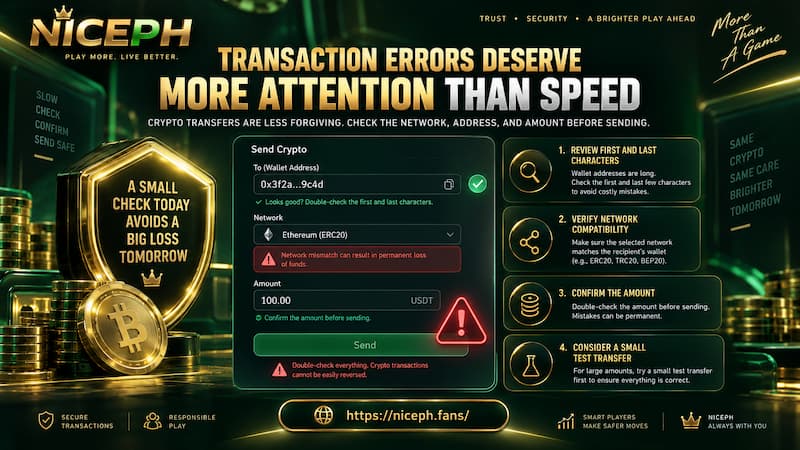
Transaction Errors Deserve More Attention Than Speed
Check Before Confirming
A practical routine is better than relying on memory:
- Copy the address instead of typing it.
- Confirm the first and last characters.
- Verify the exact network.
- Recheck the amount.
- Use a small test transfer when appropriate and supported.
The extra thirty seconds may feel unnecessary until one transaction goes wrong.
NICEPH Payment Availability
NICEPH serves a Philippine-facing online casino audience, so PHP payment convenience remains highly relevant. USDT adds another layer of interest because some users already keep funds in crypto wallets and prefer blockchain transfers.
Still, availability should never be assumed from the brand name alone.
Check the Cashier at the Time of Payment
Payment menus can change because of providers, account status, compliance requirements and regulation. Before moving funds, confirm four details directly:
Supported Token and Network
“USDT” by itself is incomplete. The network must also match.
Minimum and Maximum Amount
Limits can differ between deposit methods and account levels.
Total Fees
Look beyond the visible blockchain charge and include conversion and withdrawal costs.
Withdrawal Requirements
A deposit method does not automatically guarantee that withdrawals will follow the same route.
USDT, E-Wallets and Bank Transfers
Each payment method solves a different problem.
USDT offers portability, round-the-clock blockchain transfers and relatively stable pricing compared with volatile crypto assets. In exchange, users must deal with wallet addresses, network selection, conversion costs and stricter regulatory questions.
E-wallets feel more familiar because balances stay in PHP and day-to-day money management is straightforward. Recent gaming-payment restrictions, however, have changed how directly those services can connect with gambling activity.
Bank transfers remain familiar and leave clear fiat transaction records, but they may involve different processing arrangements and fewer of the wallet-to-wallet features crypto users value.
The strongest payment choice is therefore not automatically the newest or fastest one. It is the method that is currently available, properly supported, cost-efficient and appropriate under the rules governing the transaction.
USDT as a Payment Choice
USDT has understandable appeal: It combines a dollar-linked unit of value with blockchain portability and several network options. For people already comfortable with crypto wallets, that can feel noticeably different from moving money through conventional payment channels.
The distinction that matters for NICEPH users is simple. Interest in USDT does not guarantee permission to use it for betting. Check the current cashier, verify the network, calculate the complete cost and confirm the applicable payment rules before treating USDT as a usable option.
- View more: How Double Bets Work in Sic Bo